T TRIZ Consulting Est. 1992 · Seattle, WA Free Webinar
32 YEARS · TOP FUNCTION MODELING TRIZ MASTER · Z. ROYZEN

TOP-TRIZ. The next generation.

TOP-TRIZ is the next generation of TRIZ — three decades of development by Zinovy Royzen, a TRIZ Master. It increases effectiveness of problem formulation and problem solving while being friendlier and easier to learn and apply than Classical TRIZ.

01 / OVERVIEW

A universal system for innovation.

TOP-TRIZ is based on Tool-Object-Product function modeling, which made it possible to develop the next generation of TRIZ — making Classical TRIZ outdated. Its power has been proven by solving many challenging and “unsolvable” problems.

TOP-TRIZ has integrated next-generation TRIZ methods into a universal, very effective, and user-friendly system for innovation. It also guides teams to maximize utilization of resources in order to develop the most ideal and least expensive solutions.

A set of TOP-TRIZ courses provides learners with different levels of practical experience sufficient to achieve outstanding results. TOP-TRIZ Problem Formulator and Solver software accelerates learning and application of the method.

TOP-TRIZ methodology provides advantages in systematic innovation in order to develop better products and processes at a lower cost and in less time while being user friendly.

02 / ADVANTAGES

What TOP-TRIZ delivers.

Further development of Classical TRIZ — with universal steps, six problem classes, documented process, and faster winning concepts.

  1. Represents further development of Classical TRIZ.
  2. Helps develop breakthrough concepts and ideas because it is based on generalization of breakthrough world-wide inventions.
  3. Provides universal steps and series of guidelines for problem identification including system approach and function modeling.
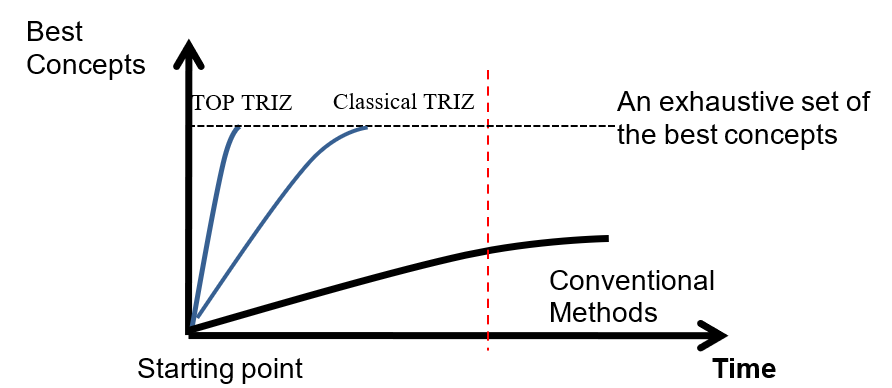
  4. Recognizes six general types of problems in innovation and guides to a series of checklists for solving problems much faster than using conventional methods.
  5. Leads to maximize usage of available resources in order to develop better products at a lower cost.
  6. Documents the steps of the solution process.
  7. Makes the steps available for review and improvement.
  8. Makes it possible to estimate the time for each step and the whole process.
  9. Lessens number of people involved and less time is needed.
  10. Increases efficiency and effectiveness of creative work.
  11. Develops winning concepts faster.
  12. Helps pursue competitive advantage.
TOP-TRIZ diagram Top TRIZ diagram

The right solution at the right time.

Elegant and valuable solutions to your most difficult design and manufacturing problems can be obtained much faster than by traditional ways. The right solution at the right time can potentially save hundreds of man-hours, millions of dollars, and accelerate a project by days, months, even years.

03 / FLOWCHART

TOP-TRIZ Flowchart.

The operational map: classify each problem, select the corresponding methods, and keep iterating through subsequent problems until none remain.

TOP-TRIZ Flow Chart TOP-TRIZ flowchart
04 / FORMULATION

TOP-TRIZ Problem Formulation.

A universal approach to analyze any situation needing an improvement — including Ideal Ways for improving the situation.

TOP-TRIZ Problem Formulation includes TOP-TRIZ Function Analysis of the current problems of the project, known solutions to these problems and their disadvantages, analysis of the history of the problem and constraints. It includes analysis of the alternatives of the system and Ideal Ways.

Ideal Ways is an analytical method made up of the ideal directions for improving the situation. For example, if a component of the system is involved in a disadvantage, Ideal Way 1 suggests two ways to get rid of the component by eliminating its function. Ideal Way 2 suggests two ways to get rid of the component by its substitution. Ideal Way 3 guides you to make the component itself eliminate its disadvantage.

TOP-TRIZ problem formulation guides you to develop an exhaustive set of problems associated with your system and its need for an innovative solution.

05 / MODELING

Tool-Object-Product Function Modeling.

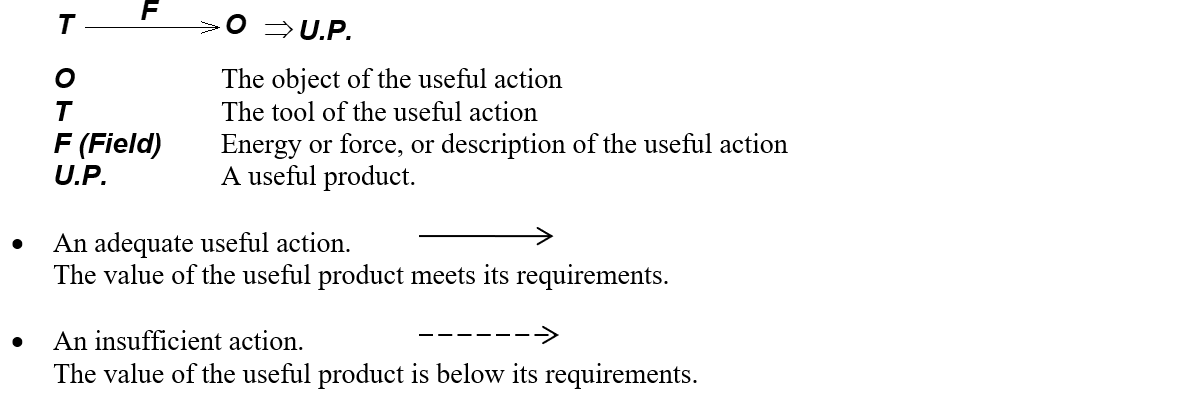
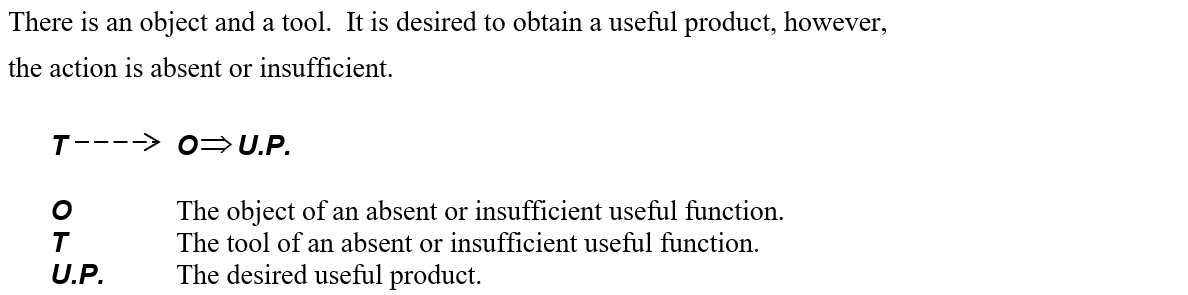
The complete model of a function has four elements: the tool, the object, the action, and the product of the function.

According to Tool-Object-Product (TOP) Modeling, the complete model of a function has four elements. It has the tool of the function (or the function provider), the object of the function (or recipient of the action of the tool), the action of the tool at the object, and one more component — the product of the function. The action is described by one arrow, which simplifies the model.

TOP Model of a Useful Function

TOP Model of a Useful Function

TOP Model of an Absent Useful Function

TOP Model of an Absent Useful Function

TOP Model of an Insufficient Useful Function

TOP Model of an Insufficient Useful Function

TOP Model of a Harmful Function

TOP Model of a Harmful Function

TOP Model of an Unknown Harmful Function

TOP Model of an Unknown Harmful Function

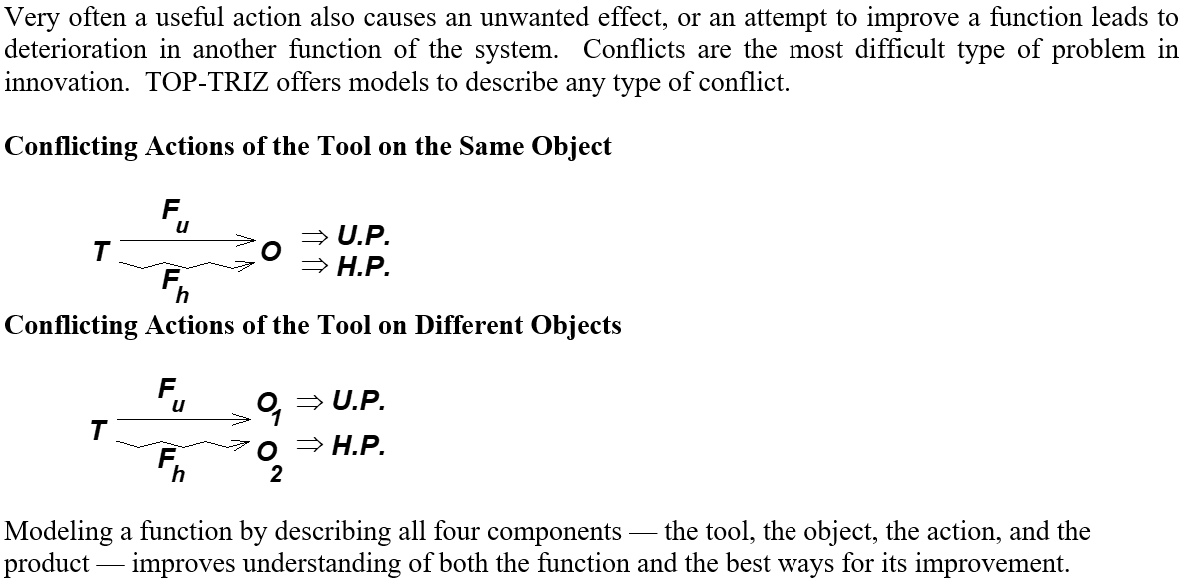
TOP Model of a Conflict

TOP Model of a Conflict
06 / ADVANTAGES

Why TOP Function Modeling matters.

A more generic way to model a function than Substance-Field Modeling — with clearer links between functions and stronger problem classification.

i.

Universal Model of a Function

Neither the tool of the function nor the object of the function has to be a substance as it is required in Substance-Field Model. In TOP-TRIZ Model, an object is anything we want to modify. It can be a field. TOP Function Modeling allows you to model any function in any system. It is a more generic way to model a function than Substance-Field Modeling.

ii.

Complete Description of a Function

Desired and unwanted products of the functions of a modeled system improve understanding of the system and simplify analysis of the system resources.

iii.

Link Between Functions

Introducing the product of a function into its model provides a very convenient and understandable link between functions. For example, a product of the first function can be a tool or an object of a subsequent function. The link between functions is important in understanding not only a desired performance of a product, but also the chain of unwanted functions. Links between functions simplify cause-effect analysis and improve the process of revealing the cause of a current or potential failure of a product.

iv.

Increasing Effectiveness of Function Analysis

TOP-Function Modeling is supported by templates to guide you in modeling any type of functions and in describing the performance of your system, its interaction with its supersystem and environment by a number of functions.

v.

Problem Classification

Any single function or a conflict can be considered separately and classified according to TOP-TRIZ Flow Chart. Function modeling helps you to understand the system’s performance, state the set of problems to consider, classify the problems, and determine the TRIZ Methods to be applied according to the TOP-TRIZ Flow Chart.

07 / SOLVING

TOP-TRIZ Problem Solving.

Six classes of problems, each with corresponding methods — based on further development of Classical Standard Solutions and ARIZ.

TOP-TRIZ Flow Chart classifies problems into six classes and offers corresponding problem-solving methods for each class of problems. TOP-TRIZ problem-solving methods are based on further development of Classical Standard Solutions and ARIZ. TOP-TRIZ guides you to develop an exhaustive set of innovative solutions. It also aims to maximize utilization of the resources of the system, its supersystem, and environment to make the best solutions inexpensive.

In the development of the next generation of Standard Solutions, they were reclassified, more Standards were added, many Standards were reformulated, many Standards were integrated, so the total number of the Standards was reduced. Reclassification of the Standards helped to develop the simplest and user-friendly TOP-TRIZ Flow Chart. Each Standard gets a step-by-step guide for its successful application. As a result, TOP-TRIZ problem-solving methods became more effective, easier to learn and apply.

Conflict Solving Algorithm. TOP-TRIZ Conflict Solving Algorithm is the next generation of Altshuller’s Algorithm for Inventive Problem Solving (ARIZ). Integration of TRIZ Methods allowed reducing the number of steps in ARIZ and improving its effectiveness. The steps were redesigned, and each step received a template.

Initial function analysis of a system has improved identification of the right conflicts. TOP function modeling improves understanding of the conflict and its opposite versions. One of the most difficult steps in ARIZ — formulation of the Macro level physical contradiction — is simplified significantly. Techniques for Physical Contradiction Separation are reformulated, supplied with step-by-step templates, and an additional technique was added. As a result, even the most difficult problems with contradictions involved can be routinely solved while minimizing product changes and costs.
08 / PROCESS

The process of TOP-TRIZ problem solving.

Formulate an exhaustive set of problems. Select one. Classify it. Apply methods. Then solve the subsequent problems that concepts bring — until none remain.

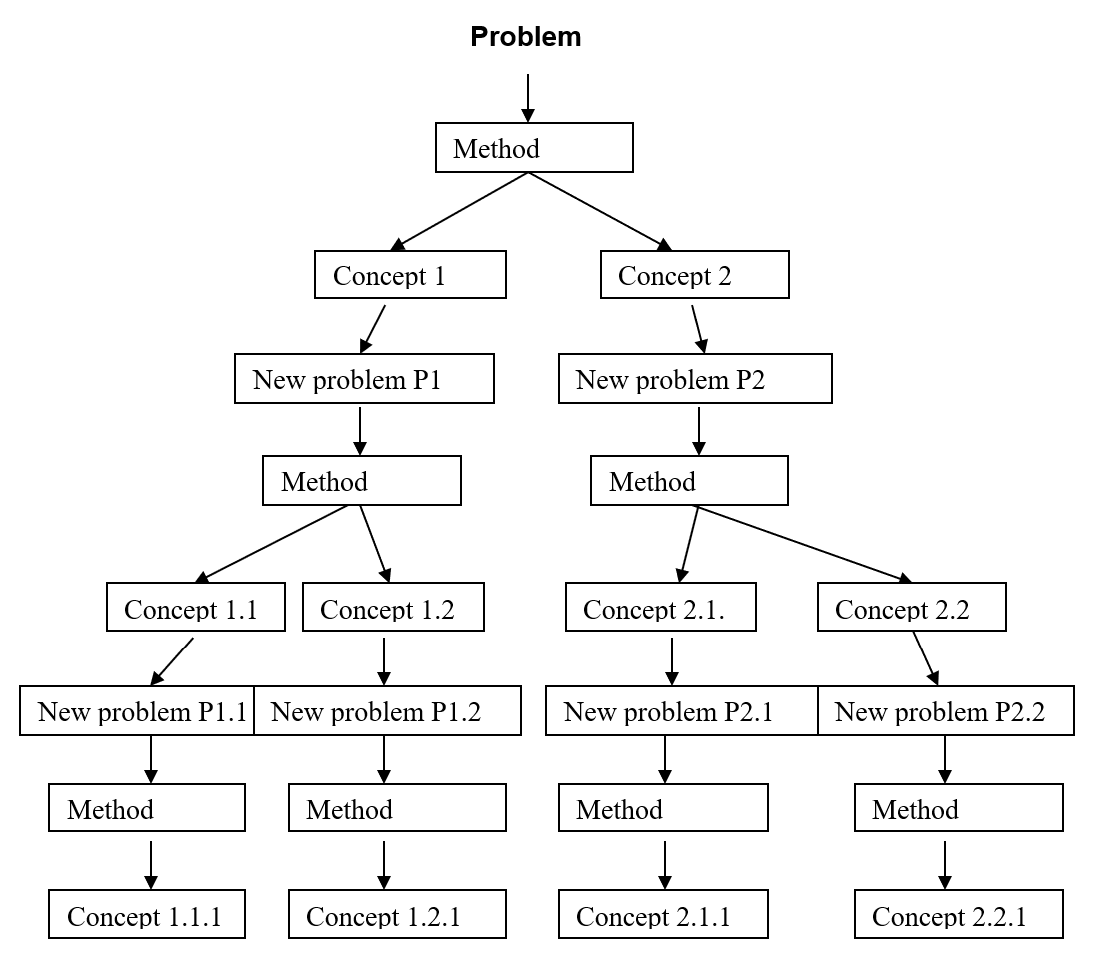
TOP-TRIZ Flow Chart guides you from the very beginning of the process. In general, problem formulation results in an exhaustive set of problems. Selecting one problem at a time, the user classifies the problem according to the TOP-TRIZ Flow Chart and identifies the methods to apply. Each method could help to develop several concepts. However, it is very seldom that any of the concepts could be implemented right away. In most cases, any concept could bring at least one or two subsequent problems.

Subsequent Problems. No matter what class the original problem is, the most common subsequent problems are the following:

  1. A concept while solving the first problem causes deterioration of a feature or a function. So, it is a conflict.
  2. A concept requires modifying a resource or deriving what is needed to solve the first problem out of an available resource. This class of problems is an absent action.
  3. A new action has to be performed at a certain time. This class of problems is detection or measurement.

In the worst situation, a concept might cause all three subsequent problems together.

And again, several concepts could be developed to solve this new problem. And again, the best concept might bring its own new problems. And again, new problems have to be classified according to TOP-TRIZ Flow Chart. And so on, until there are no more new problems needing innovative solutions.

TOP-TRIZ methodology guides you in your project to formulate an exhaustive set of problems associated with your system, the current problem, and your objectives. Then, TOP-TRIZ guides you to develop an exhaustive set of the best solutions. This approach helps you not only select the most ideal solution for implementation. Having the exhaustive set of the commercially applicable solutions is the basis for a reliable patent protection of your business.

Solution Tree TOP-TRIZ Solution Tree

TOP-TRIZ Solution Tree.

TOP-TRIZ allows documenting all steps of the solution process and building the Solution Tree for each problem.

All steps can be reviewed and corrected, if necessary.

The steps can be used as examples for solving new problems.

09 / TRAINING

Teaching TOP-TRIZ.

The complete program includes three 40-hour courses — foundations, advanced practice, and practitioner.

  1. 01
    Designing and Manufacturing Better Products Faster Using TRIZ Basic course. A 40-hour course and can be conducted as a five-day course.
  2. 02
    Advanced Practice TRIZ Course An entirely practice course (21 cases). Can be conducted as a five-day course or remotely via WebEx 2 hours a week.
  3. 03
    TRIZ Practitioner Course Also an entirely practice course (21 cases). Can be conducted as a five-day course or remotely via WebEx 2 hours a week.
10 / CURRICULUM

Foundations program topics.

The program of Designing and Manufacturing Better Products Faster Using TRIZ.

  1. Basic concepts of TRIZ
  2. Analysis of a system and problem formulation
  3. Solving a class of problems called Insufficient Function
  4. Solving a class of problems called Conflict
  5. Solving a class of problems called Harmful or Unwanted Function
  6. Solving a class of problems called Measurement
  7. Solving a class of problems called Revealing the Cause of a Failure
  8. Technology Forecasting
  9. Concept evaluation
  10. Combined application of TRIZ Methods
  11. Solving problems brought by participants
  12. TOP-TRIZ Problem Formulator and Solver software

Advanced Courses. The objective of the advanced courses is to help TRIZ users in gaining advanced-level experience in applying TRIZ and confidence in working on their real-life problems and facilitation of TRIZ facilitation of teams.

11 / SOFTWARE

Learning, applying, and facilitating.

Designed to help learning TOP-TRIZ, applying it, and facilitating teams — with the same terminology and steps as training materials.

The software was designed to help learning TOP-TRIZ, applying it and facilitating teams. It uses the same terminology and steps as training materials. It prevents beginners from making many typical mistakes.

The software includes all steps of TOP-TRIZ problem formulation and all steps of TOP-TRIZ revealing causes of a failure (TOP-TRIZ Root Cause Analysis), TOP-TRIZ Conflict Solving Algorithm and Physical Contradiction Separation Methods, TOP-TRIZ Direct Ways for Harmful Action Elimination and TOP-TRIZ Building a Sufficient Function. The software is supplied with a customized list of physical fields and effects.

The TOP-TRIZ courses provide the learners with practical experience sufficient to achieve outstanding results.

For more information regarding TOP-TRIZ training please see http://www.trizconsulting.com/training.html

For testimonials, please see http://www.trizconsulting.com/testimonials.html

Put the method to work

Bring TOP-TRIZ to your next hard problem.